
We put it this way on purpose. "Bamboo is sustainable" has become a sales line, and that does not help you if you just want to make an honest choice.
Where bamboo wins
Bamboo is not a tree, it is a grass. That sounds like a detail, but it changes everything.
A grass grows back after you harvest it. You do not have to replant anything. In the growing season, some bamboo species shoot up tens of centimeters a day. It needs no fertilizer, no pesticides, and far less water than many other crops.
Translated to a product: the raw material grows back fast, does not exhaust the soil, and ends up bio-based instead of fossil plastic. That is exactly why you see bamboo more and more where there used to be only plastic, in toothbrushes and in the heads for your electric brush. A plastic handle or head starts as crude oil and ends up in a landfill or the sea. A bamboo handle started as grass.
So if the question is "is bamboo better than plastic", then for most bathroom items the answer is: yes.
But does that transport not count?
Fair question, and the honest answer is: it does. Bamboo mostly grows in Asia. That means transport, and transport has a cost. We do not think you should paper over that with a pretty picture of a forest.
So we had it calculated. We compared the total CO2 emissions of a bamboo toothbrush with those of an ordinary plastic toothbrush, also from China, so transport counted on both sides. The result: the bamboo toothbrush comes out at around 19 grams of CO2, against more than 40 grams for the plastic one. Well over half less, including the trip over here.
One toothbrush, and still half. That is the point of bio-based: it wins not because it grows far away, but in spite of growing far away.
Where it is not 100 percent
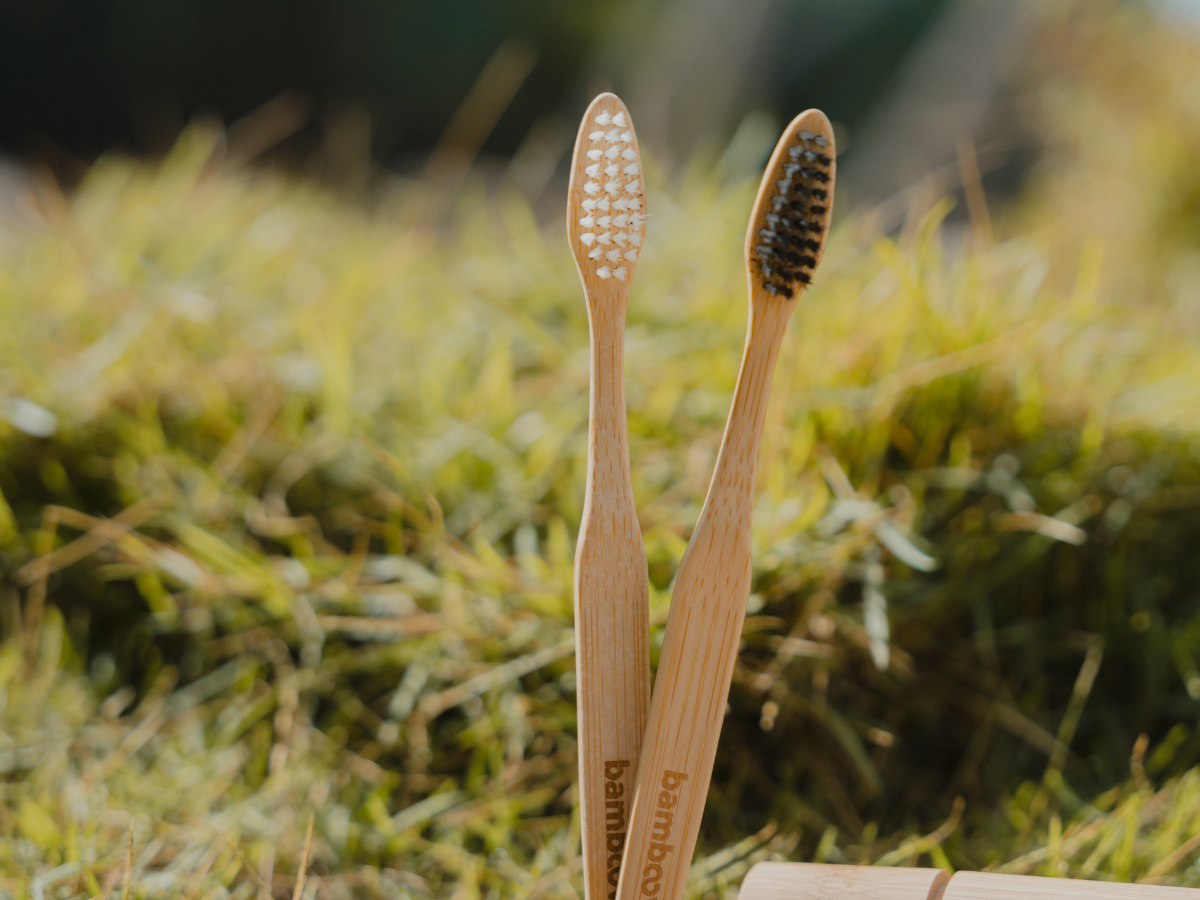
Look at a brush head, and you will fortunately find out that the bristles are not bamboo. Bristles have to be fine and firm. For that, we use bio-based nylon made from castor oil, from the castor bean, instead of nylon from crude oil. Better, but not nothing. That is why we say 99 percent plastic-free, not 100 percent. That one percent is still there, and we do not pretend otherwise.
We know how to fight the last percent. With our razors, we wanted to get plastic out all the way into the cartridge. That final bit turned out so stubborn that at some point we launched anyway, with a nearly fossil-free make-up, rather than wait forever for a perfect 100 percent. That same honest story sits in the brush heads: we would rather say 99 percent and be right, than 100 percent and overstate it.
The question under the question
What people usually really mean when they type "is bamboo sustainable" is this: will I not feel silly later for buying something that turned out to be dressed up nicer than it was?
Honest answer: one bamboo brush will not save the world, and it does not have to. The difference is in the repetition, and it only starts to mean something when you spread it over years.
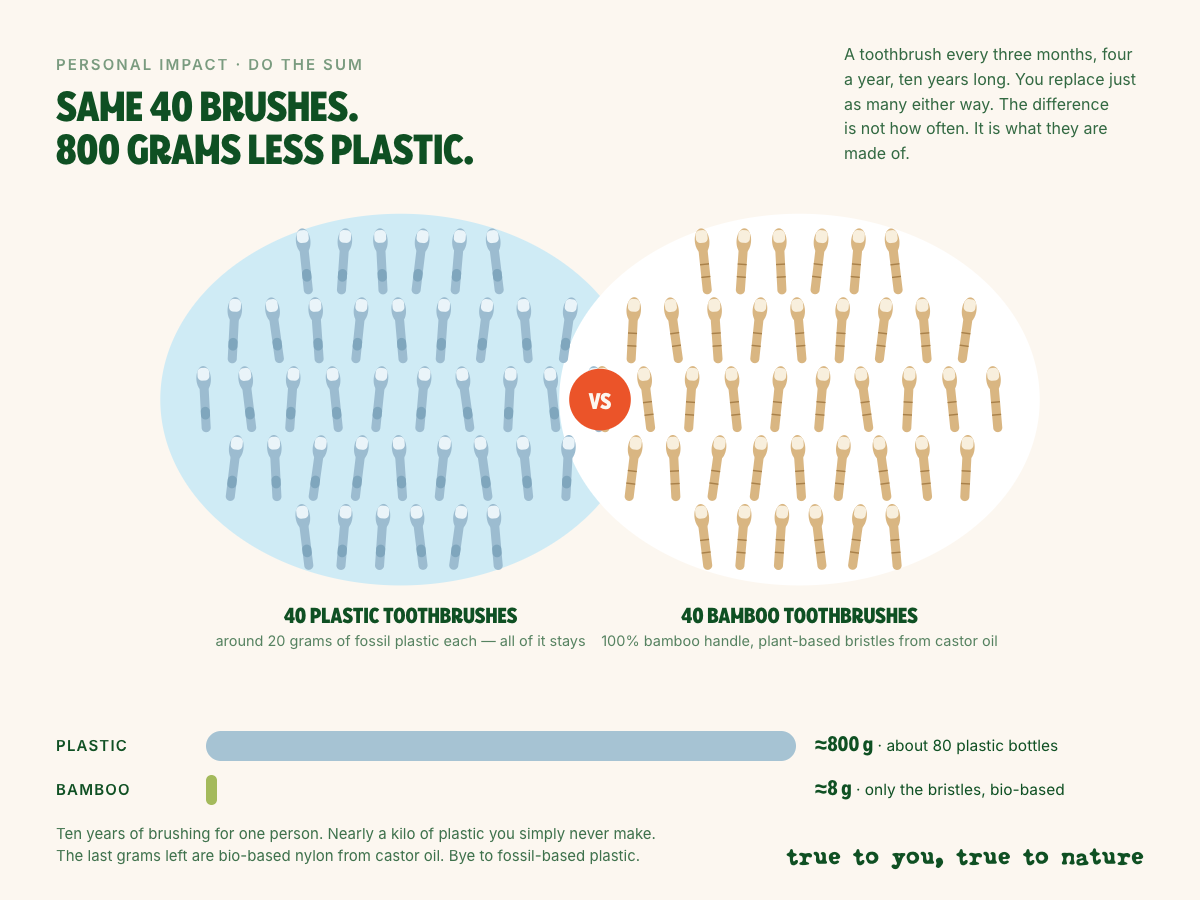
Do the sum. You swap a brush head roughly every three months, so four a year. Over ten years, that is forty heads. At around 20 grams of plastic per head, that comes to about 800 grams, nearly a kilo of plastic that you simply never make over ten years. Roughly eighty plastic bottles, from one person, in one bathroom.
And that is just you. For tens of thousands of people taking part, it is no longer kilos, but tonnes. Without anyone having to turn their whole life upside down.
That is the whole idea behind a swap. Not your entire bathroom at once, not a lifestyle. One thing you already use every day, made from bio-based materials.
The swap, if you want it
An easy place to start, because you already use it: our bamboo toothbrush or brush heads for electric toothbrushes. We offer alternatives to Sonicare® and Oral-B® plastic replacement brushes.
They fit all Oral-B models, except the iO and the Pulsonic, and click on the way you are used to. The bristles are bio-based nylon made from castor oil, dentist-tested, and the head is 99 percent plastic-free. For sonic models, check the product page for the full compatibility list.
Want to read on first? This is a good next one: how often to replace your brush head.
Frequently asked questions
Is bamboo really sustainable, or is it marketing?
Bamboo is a fast-growing grass that comes back after harvest, needs no fertilizer or pesticides, and is bio-based instead of fossil-based. That is real. The nuance is transport from Asia and parts that cannot be bamboo, like bristles. That is why we say 99 percent plastic-free, not 100.
Does the transport from Asia not cancel out the gain?
We had it calculated. The total CO2 emissions of a bamboo toothbrush, transport included, come out at around 19 grams, against more than 40 grams for a plastic toothbrush that also came from China. Well over half less, including the trip over here.
How much plastic does it really save?
For one brush head, little. Over ten years, a lot. Four heads a year, ten years long, at around 20 grams of plastic each, is nearly a kilo of plastic per person. For tens of thousands of people taking part that adds up to tonnes.
Is bamboo better than plastic for a toothbrush or brush head?
For both, bamboo wins, because the raw material grows back fast and is bio-based, while plastic starts as crude oil and does not break down. The gain is mostly in repetition: things you replace often add up.
Why are the bristles not made of bamboo?
Bristles have to be fine and firm, which bamboo cannot deliver. We use bio-based nylon made from castor oil, from the castor bean, instead of nylon from crude oil. Hence 99 percent plastic-free.
Which Oral-B does a bamboo brush head fit?
All Oral-B models, except the iO and the Pulsonic. For sonic models like Sonicare, the full list is on the product page.

.png)